Cosmology and constraints on the parameters of sterile neutrinos
As a part of my doctoral thesis, I investigated the sensitivity of the SRG mission (eRosita / ART-XC) to search for traces of dark matter decay. Together with Professor Dmitry Gorbunov, Dr. Roman Krivonos and Dr. Rodion Burenin, we studied the expected constraints on the parameters of sterile neutrinos that can be set during the SRG mission [1]. Additionally, we analyzed the prospects for searching for traces of dark matter decay from other sources, such as Andromeda and Draco. During this work, I gained experience working with X-ray spectra and data analysis. Additionally, correlation analysis of cosmic structures and spatial distribution of galaxies using the 2MRS catalog data was carried out, taking into account the updated data on the X-ray background for the telescopes of the SRG mission. In this work, I calculated the angular cross-correlation power spectra in the Limber and extended Limber approximations based on the HaloModel and HOD models and the CAMB software package. We obtained the expected constraints on the parameters of sterile neutrinos for the eROSITA telescope and showed that the predicted constraints are generally consistent with what has been previously studied by other groups. The same analysis was performed for the ART-XC telescope [2]. In addition to the constraints on the parameters of decaying / annihilating dark matter that can be obtained from the SRG mission, we analyzed the spectra from NuSTAR data. In this work, we obtained some of the most stringent constraints on the parameters of sterile neutrinos [3, 4].

[1]. V. V. Barinov, R. A. Burenin, D. S. Gorbunov, and R. A. Krivonos. Towards testing sterile neutrino dark matter with the Spectrum−Roentgen−Gamma mission. Phys. Rev. D, 103(6):063512, 2021.

[2]. V. V. Barinov. Correlation analysis of decaying sterile neutrino dark matter in the context of the SRG mission. JCAP, 02, 055, 2023.

[3]. R. A. Krivonos, V. V. Barinov, A. A. Mukhin, D. S. Gorbunov. Strong limits on keV-scale galactic sterile neutrino dark matter with stray light from NuSTAR after 11 years of operation. Phys. Rev. Lett. 133, 261002, 2024.

[4]. E. I. Zakharov, V. V. Barinov, R. A. Burenin, D. S. Gorbunov, and R. A. Krivonos. Constraints on the parameters of keV-scale mass annihilating Dark Matter obtained with SRG/ART-XC observations. Phys. Rev. D 110, 123026, 2024.

Data analysis to search for sterile neutrinos
As part of my work with the BEST collaboration, we obtained the first refined estimates of the sensitivity of the BEST experiment to models with light sterile neutrinos mixed with electron neutrinos [1]. The possible impact of future results of the BEST experiment on the status of the gallium anomaly was studied [2]. After the experiment was completed and the first results were obtained, I was directly involved in the analysis and interpretation of the results of this experiment. In particular together with Professor Dmitry Gorbunov, we showed that the results of the BEST experiment are consistent with the results of the SAGE and GALLEX experiments, and the NEUTRINO4 reactor antineutrino experiment, but the results of other reactor antineutrino experiments differ from the results of the latter. We have shown that the explanation of the result of the BEST experiment within the framework of the hypothesis of the presence of one light sterile neutrino, in the course of a joint analysis of data from other oscillation experiments, indicates a region of large masses and mixing angles of sterile neutrinos [3].

[1]. Vladislav Barinov, Vladimir Gavrin, Dmitry Gorbunov, and Tatiana Ibragimova. BEST sensitivity to O(1) eV sterile neutrino. Phys. Rev. D, 93(7):073002, 2016.

[2]. Vladislav Barinov, Vladimir Gavrin, Valery Gorbachev, Dmitry Gorbunov, and Tatiana Ibragimova. BEST potential in testing the eV-scale sterile neutrino explanation of reactor antineutrino anomalies. Phys. Rev. D, 99(11):111702, 2019.

[3]. Vladislav Barinov and Dmitry Gorbunov. BEST impact on sterile neutrino hypothesis. Phys. Rev. D, 105(5):L051703, 2022.
Deep inelastic scattering
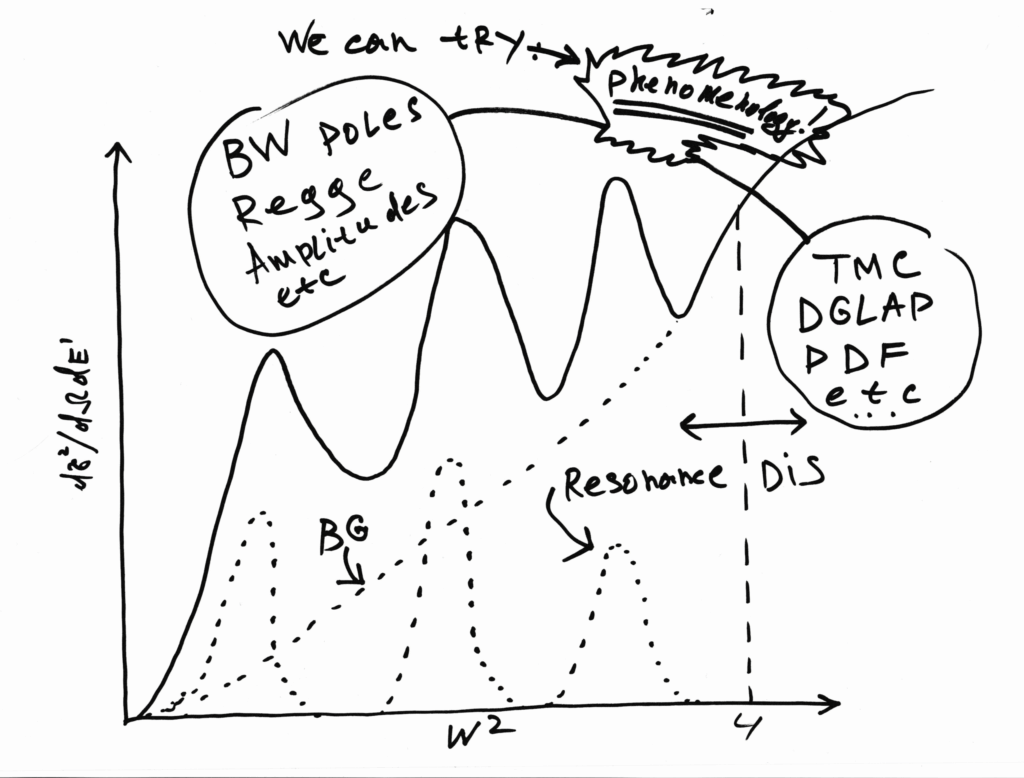
Together with Dr. Sergey Kulagin, we developed a semi-phenomenological model of the inelastic structure functions of the proton, applicable both to deep inelastic scattering (DIS) at high energies and to the region of excitation of nucleon resonances. In the course of our work, we developed a model that is in good agreement with the data on inelastic cross sections for electron scattering on a proton and total photoproduction cross sections. It was also shown that the values of the F2 structure functions and the FL/FT ratio predicted by the model are also in good agreement with the available data. This suggests its use in the analysis of processes with nuclei, as well as for neutrino scattering in the resonant and transition regions [1].

[1]. S. A. Kulagin and V. V. Barinov. Hybrid model of proton structure functions. Phys. Rev. C, 105:045204, 2022.
Calculation of neutrino absorption cross sections
There are several approaches to explain the so-called gallium anomaly. One of them is that the observed deficit in the electron neutrino flux compared to the expected flux may be associated with an overestimation of the neutrino capture cross section on the target matter. To investigate this issue, a study to refine the neutrino absorption cross section on gallium for the BEST experiment was conducted. Revised neutrino capture cross sections for gallium were calculated for the artificial sources 51Cr and 37Ar and for the first time for the artificial source 65Zn based on measurements of the matrix elements of transitions in the charge exchange reaction 71Ga(3He, t)71Ge and based on the value of the threshold energy for the transition of gallium to the ground state of germanium, equal to Q = 233.5 ±1.2 keV. This made it possible to refine the neutrino capture cross section on gallium with a resulting error not exceeding 2.3%, as well as to clarify the contribution of excited levels to the total capture cross section. Based on these data, the gallium anomaly was revised and it was shown that taking into account the uncertainties of the matrix elements does not explain the anomalous result of the SAGE and GALLEX experiments. Additionally, we demonstrated the potential of a zinc source for testing the gallium anomaly [1].

[1]. Vladislav Barinov, Bruce Cleveland, Vladimir Gavrin, Dmitry Gorbunov, and Tatiana Ibragimova. Revised neutrino-gallium cross section and prospects of BEST in resolving the Gallium anomaly. Phys. Rev. D, 97(7):073001, 2018.